
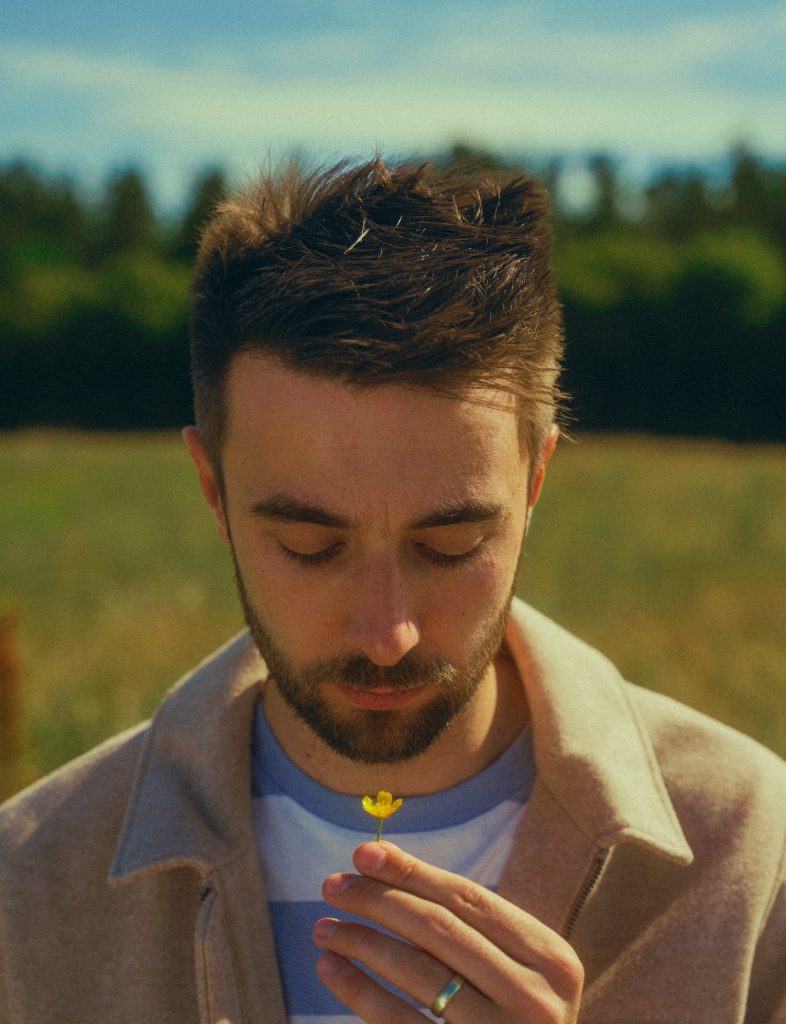
Mat Hunsley, a Newcastle-based songwriter who blends folk intimacy with alternative textures, emerges as a compelling new voice in the UK’s contemporary folk and alternative scene. His long-awaited debut album The Things We Need arrived March 13th, supported by the PRS Open Fund. Now a fully qualified doctor after years balancing the emotional demands of medical training with songwriting dedication, and inspired in his late teens by Ben Howard, Nathaniel Rateliff, and Bon Iver, Hunsley delivers a self-produced collection of deeply personal reflections and unflinching social commentary. The album is elevated by standout collaborations with drummer Matt Hardy (Lanterns on the Lake, Lovely Assistant) and string arranger Joseph Lawrenson (Dancing Years).
In this exclusive interview, Mat Hunsley discusses the lived experiences, creative instincts, and convictions that shaped his debut and positioned him as a thoughtful presence merging vulnerability with impact.
What first inspired you to start writing songs as a teenager?
Honestly, I wasn’t one of those kids who grew up surrounded by instruments or parents who played in bands. Music didn’t really hit me properly until I was about 15 or 16. Before that, it was just… there. But once I found music that actually resonated with me, it was like someone had flicked a switch.
My first proper go at playing was in a cover band with my best mates called The Shambles. We did exactly what every teenage cover band was doing at the time — Arctic Monkeys, Bombay Bicycle Club, Two Door Cinema Club — and it was brilliant fun. But even then, I knew my heart was leaning more towards folk music.
Nathaniel Rateliff was the one who really lit the spark. The way he could create so much emotion with just his voice and a guitar absolutely floored me. I remember thinking, “I want to be able to do that. I want to make someone feel something like that.” That’s when I started writing.
In what ways have Ben Howard, Nathaniel Rateliff, and Bon Iver shaped your sound and the way you write songs?
They’ve all shaped me in different ways. Ben Howard’s guitar playing is just… ridiculous. I’ve never seen anyone play like that. He somehow manages to be completely distinctive and still write songs that feel accessible, and that’s something I’ve always admired.
Bon Iver showed me the magic of atmosphere. Those early records — For Emma especially — feel like they were built out of thin air. And then everything he’s done since has been wonderfully weird and imaginative. His production is what made me want to get into that side of things myself.
And then there’s Nathaniel Rateliff, who’s probably the biggest emotional influence on me. Back in 2013, when I was running the Newcastle Sofar Sounds nights, I sent his manager a hopeful email and somehow convinced Nathaniel and his band to come play in my student living room. We froze them half to death — genuinely — and they only stayed for one of the two nights they’d planned. But watching him perform from a few feet away was like witnessing a masterclass. That experience has stuck with me ever since.
What draws you to mix the intimacy of folk music with alternative sounds?
I love the honesty of folk music — that feeling of someone just telling you the truth. But I’ll be honest: straight‑up acoustic music can sometimes feel a bit bland or predictable to me. I’ve always been drawn to artists who use production to make a song stand out, to give it a bit of atmosphere or weirdness or texture.
It’s not that I don’t like traditional folk — I do — but I’ve always admired people who blend genres. It’s something I’ve always wanted to do myself. Start with something small and intimate, and then build a world around it. That’s the sweet spot for me.
How has your experience as a doctor influenced the themes on The Things We Need?
It’s impossible for it not to. When you work in healthcare — and especially in the NHS — it bleeds into your daily life whether you want it to or not. Only one song on the album, There’s Been a Death, directly references my work, but the rest of the themes are absolutely shaped by it.
Passenger came from worrying that life is passing me by while I’m working overtime, missing moments with my family that I desperately want to be present for. Happy in the Dark came from the internal debate of whether to hide from the news for the sake of self‑preservation — something I found myself doing a lot during the pandemic, when I was overwhelmed at work and then overwhelmed again at home by the constant fear on the TV.
You can’t do this job and not have it seep into your writing. It’s just part of how I see the world now.
At this stage in your life, what does the title The Things We Need mean to you?
For me, it’s a reminder not to forget what’s actually important. I’m someone who tries to do more and more and more — always spinning plates, always taking on something else — and the title is my way of grounding myself.
It’s about remembering that my life is already full of the things I need. My family, the people I love, the small moments that make everything worthwhile. If you’re lucky enough to feel that, then you don’t need to go searching for something bigger or shinier.
It’s something I have to remind myself of constantly.
How did the title track grow from a gentle acoustic piece into its big cinematic finish?
Like most of the songs, it started on an acoustic guitar. At that point I was still figuring out how to produce anything — I’d never produced for myself or anyone else before this album — so there were a lot of false starts. But The Things We Need was the first track where I felt like I actually knew what I was doing.
I always knew I wanted it to build into this big, emotional middle‑eight before dropping back down again at the end. I toyed for ages with the idea of adding drums, but eventually realised I could create the tension and swell without them.
My friend Josh Ingledew helped me get it over the line with some additional production — including that big Moog‑y synth bass near the end. That was the moment it finally felt like the song I’d been hearing in my head.
What inspired you to write There’s Been a Death as such an honest look at the NHS?
It came from a place of genuine fear and frustration. I could feel the NHS becoming more stretched, and I felt like the staff were shouting into the void about how hard things were getting. Stories of ambulances queueing outside overflowing A&Es terrified me — I worried that one day someone I love might be the person who doesn’t make it through the doors in time.
I’ve seen expectations rise while funding falls, and the gap between those who can pay privately and those who can’t grow wider. I love working in the NHS, but it’s hard battling on in a system where the goalposts keep moving. Writing the song was my way of processing that.
Was it challenging to balance medical training with the vulnerability of making this album?
Oh, absolutely. I couldn’t have picked a worse time to take on a debut album if I’d tried. I was still finishing GP training, and both of my daughters were born during the process. For the longest time, progress was painfully slow because I just couldn’t manage everything at once.
There were moments where I genuinely wondered if I’d ever finish it. But that’s part of why I’m so proud of it now. It was made in the margins of an already full life, and getting it over the line feels like a real achievement.
Is there a song on the album that felt especially personal or vulnerable to share?
The title track, without a doubt. The whole sentiment of it is something I have to remind myself of constantly, and a lot of the lines are basically things my wife has said to me over the years — little reminders to be present, to slow down, to actually live in the moment.
It does make me a bit sad to admit I haven’t always managed that, but I felt like it was important to share. I think a lot of people feel the same way, even if they don’t say it out loud.
Now that the album is about to be released, what are you most excited for?
Honestly, I’m just excited — and relieved — to finally let these songs go. I’ve held onto them for such a long time, mostly in isolation, and I can’t wait for them to hopefully become special to someone else.
I’m excited to tour, to visit new places with a collection of songs that finally feels like me. And I’m excited to lean further into music — whether that’s writing, producing, or collaborating more with the people I’ve met over the last couple of years.
Mostly, I’m excited to enjoy music for what it should be: something shared with other people.
Stream The Things We Need:
Follow Mat Hunsley:
Spotify – Instagram – Facebook – TikTok – Youtube

Leave a reply